The daguerreotype
1839 (announced 7 January; details published 19 August)
A silvered copper plate, made sensitive with iodine and developed with mercury vapour, gave a mirror-like image of astonishing detail. It was the first photographic process sold to the public.
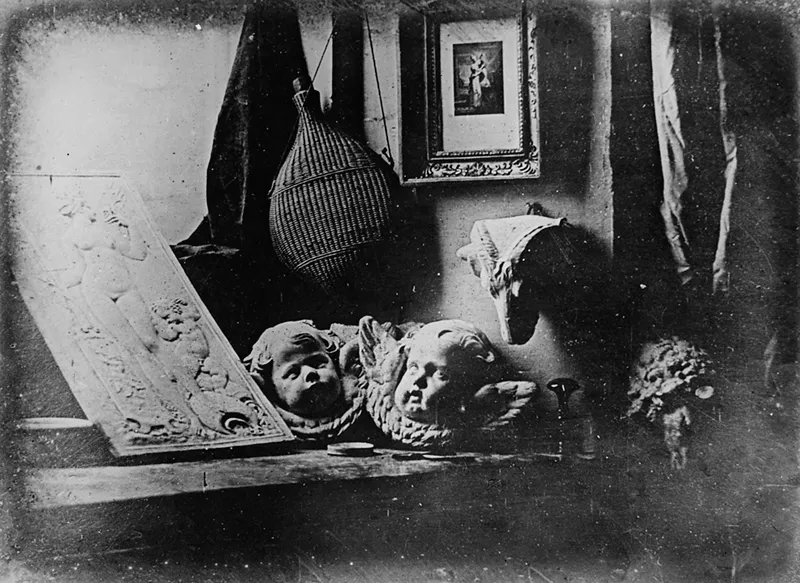
How it began
Louis Daguerre, a Paris painter of theatre scenery and showman of the Diorama, became Niépce’s partner in 1829. After Niépce’s death he kept experimenting with silver-coated plates. In 1835 he found that an invisible image on an exposed plate could be brought out with mercury vapour, which cut exposures from hours to minutes. On 7 January 1839 the scientist François Arago announced the invention. The French government bought the rights and, on 19 August 1839, published the method for anyone to use, except in England, where Daguerre had taken out a patent.
How it works
A copper plate coated with polished silver is held over iodine vapour, which forms a light-sensitive layer of silver iodide. In the camera, light makes a latent image. Fumes of heated mercury form a bright amalgam where light struck, and a salt solution, later hypo, removes the unexposed iodide. The result is a mirror-like positive that looks negative or positive depending on the angle, sealed under glass because a finger could wipe it away.
Why it mattered
The daguerreotype was the first practical photographic process, and it spread around the world within months. Its detail amazed viewers: every brick and leaf was there. Faster lenses, such as the Petzval portrait lens, and chemical “accelerators” soon cut exposures to seconds. Portraits became the trade’s mainstay, and for the first time ordinary people had exact likenesses of their families.
Limits and what replaced it
Each daguerreotype is unique: there is no negative, so it cannot be copied except by photographing it again. Plates were fragile, the image is reversed left to right, and mercury fumes were dangerous. By the late 1850s collodion glass negatives and cheaper ambrotypes and tintypes had taken over.
Today
A small number of artists still make daguerreotypes by hand, in the original way.
Sources
- Library of Congress: Daguerreotypes collection ↗
- Wikipedia: Daguerreotype ↗
- Eder, ch. XXI–XXVI (pp. 209–245); Eder lists the 1839 stages: 7 Jan, 7 Feb, 14 Jun, 3 Jul, 30 Jul, 19 Aug