Niépce's heliography and the oldest surviving camera photograph
c. 1826–27 (View from the Window at Le Gras); experiments from 1816
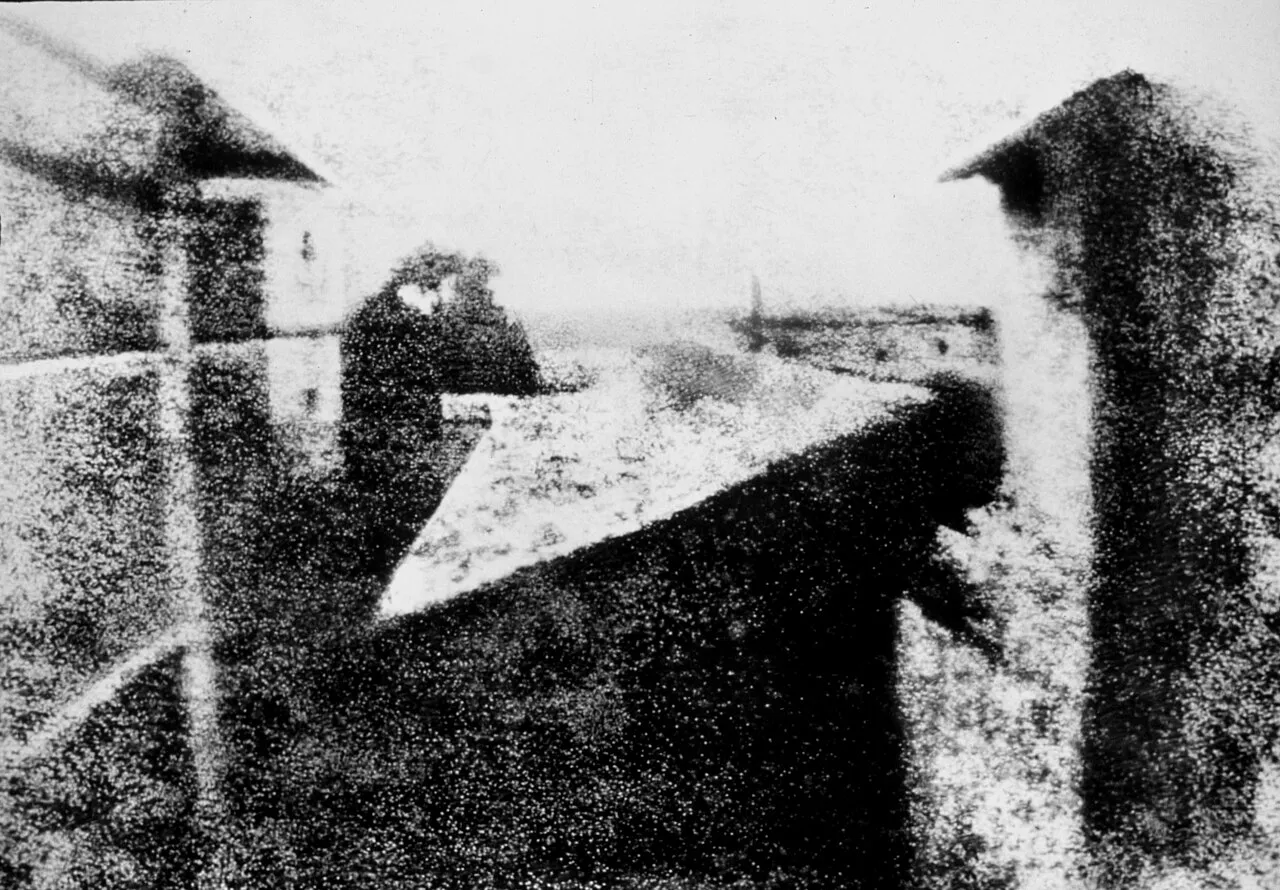
Nicéphore Niépce fixed a camera image on a pewter plate coated with bitumen, after an exposure of many hours. It is the oldest surviving photograph taken with a camera.
How it began
Nicéphore Niépce, an inventor in Burgundy, wanted a way to copy engravings for printing without drawing them. From 1816 he caught camera images on paper coated with silver chloride, but they turned dark. He then tried bitumen of Judea, an asphalt that hardens where light falls on it. Around 1826–27 he coated a pewter plate with it, set it in a camera at an upstairs window of his house at Le Gras, and left it exposed for many hours.
How it works
Light hardens bitumen. After the exposure Niépce washed the plate with oil of lavender and white petroleum, which dissolved the bitumen that had stayed soft in the shadows. The hardened bitumen remained as the light parts of the image, against bare dark metal. He called the process héliographie, sun-writing.
Why it mattered
This is the oldest surviving photograph made in a camera: rooftops, a pear tree and a barn, lit by a sun that moved across the sky during the exposure. It proved that a camera image could be kept. Niépce’s partnership with Louis Daguerre, from 1829, led to the daguerreotype.
Limits and what replaced it
Exposures of many hours made pictures of people impossible. Daguerre’s silver-iodide plates, developed with mercury, cut the time to minutes.
Today
The original plate is on permanent display at the Harry Ransom Center in Austin, Texas.
Sources
- Harry Ransom Center: The first photograph ↗
- Wikipedia: View from the Window at Le Gras ↗
- Eder, ch. XIX–XXII (pp. 193–215). Eder places a lost camera image in 1822.