The camera obscura principle
c. 5th–4th century BCE (the Mohist Canon in China; Aristotle's circle in Greece)
Light passing through a small hole into a dark room paints an upside-down image of the world outside. Every camera is still a dark chamber with a hole.
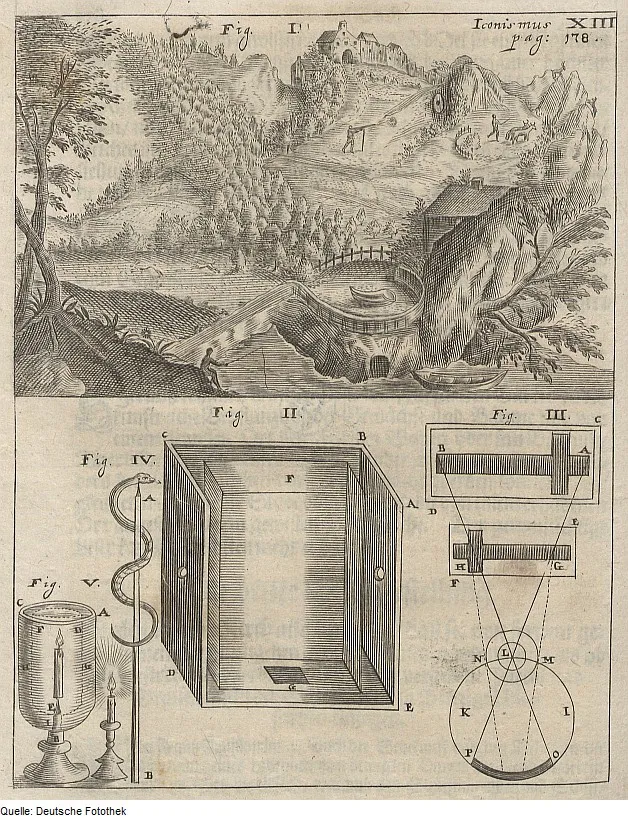
How it began
Nobody invented the camera obscura; people noticed it. Sunlight coming through a gap in a shutter or between leaves throws a faint, upside-down picture of the scene outside onto the wall or ground opposite. Texts of the Chinese Mohist school, written around the 4th century BCE, explain this inverted image. Greek writers of Aristotle’s circle puzzled over why sunlight through a square gap still makes a round spot, and a crescent one during an eclipse.
How it works
Light travels in straight lines. Each point of a bright scene sends rays in every direction, but only a narrow bundle from each point gets through a small hole. Rays from the top of the scene arrive at the bottom of the far wall, and rays from the left arrive on the right, so the image is upside down and reversed. A smaller hole gives a sharper but dimmer image, until diffraction blurs it again; see light and the pinhole.
Why it mattered
The camera obscura is the camera, without a way to keep the picture. Astronomers used it to watch eclipses safely, and later artists traced from it. For more than two thousand years the only missing ingredient was a surface that would keep the image.
Limits and what replaced it
A bare hole lets in very little light, so the image is dim. From the 16th century a lens in the opening made it brighter and sharper. Portable boxes with lenses and mirrors followed. These were the drawing aids that Niépce, Daguerre and Talbot started from.
Today
Every camera, from a pinhole tin to a smartphone, is a dark box that lets light in through one opening.
Sources
- Stanford Encyclopedia of Philosophy: Mohist Canons ↗
- Wikipedia: Camera obscura ↗
- Eder, ch. V (p. 36): history of the camera obscura