Ibn al-Haytham's Book of Optics
c. 1011–1021 (written in Cairo)
Ibn al-Haytham showed by experiment that we see because light enters the eye, and used the dark chamber to prove that light travels in straight lines.
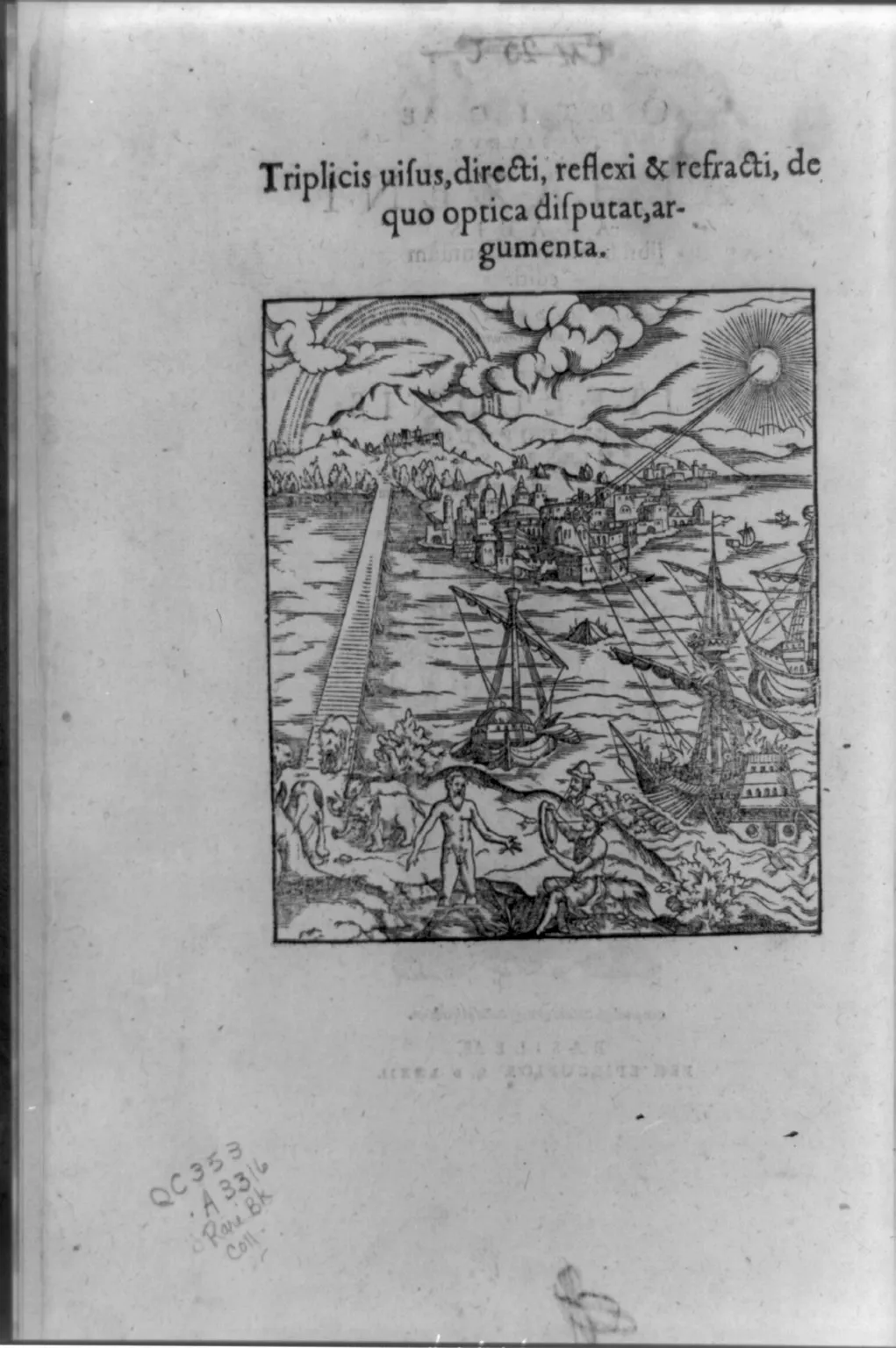
How it began
Ibn al-Haytham, a scholar from Basra working in Cairo, wrote his seven-volume Kitāb al-Manāẓir in the early 11th century. Before him, many thinkers held that the eye sends out rays to touch what it sees.
How it works
He reasoned and tested the opposite: light comes from objects into the eye. In one experiment he set several lamps outside a dark chamber with a small opening. Each lamp made its own separate spot of light on the inside wall, opposite the lamp. Covering a lamp removed only its spot, which showed that the light travelled in straight lines through the hole without mixing.
Why it mattered
His careful, repeatable experiments made optics an experimental science. Latin translations of the book shaped European optics for centuries, including the work of Kepler, who explained the camera obscura and the eye.
Limits and what replaced it
His account of how the eye forms an image was incomplete. Kepler, in 1604, was the first to explain that the eye’s lens forms an inverted image on the retina, as a lens does in a camera.
Today
His experimental approach and his model of light entering the eye underlie all later optics.