Spectacle lenses
About 1286, northern Italy
Glass grinders in northern Italy made convex lenses to wear for reading. Cheap, good glass lenses became a trade, and every camera lens descends from it.
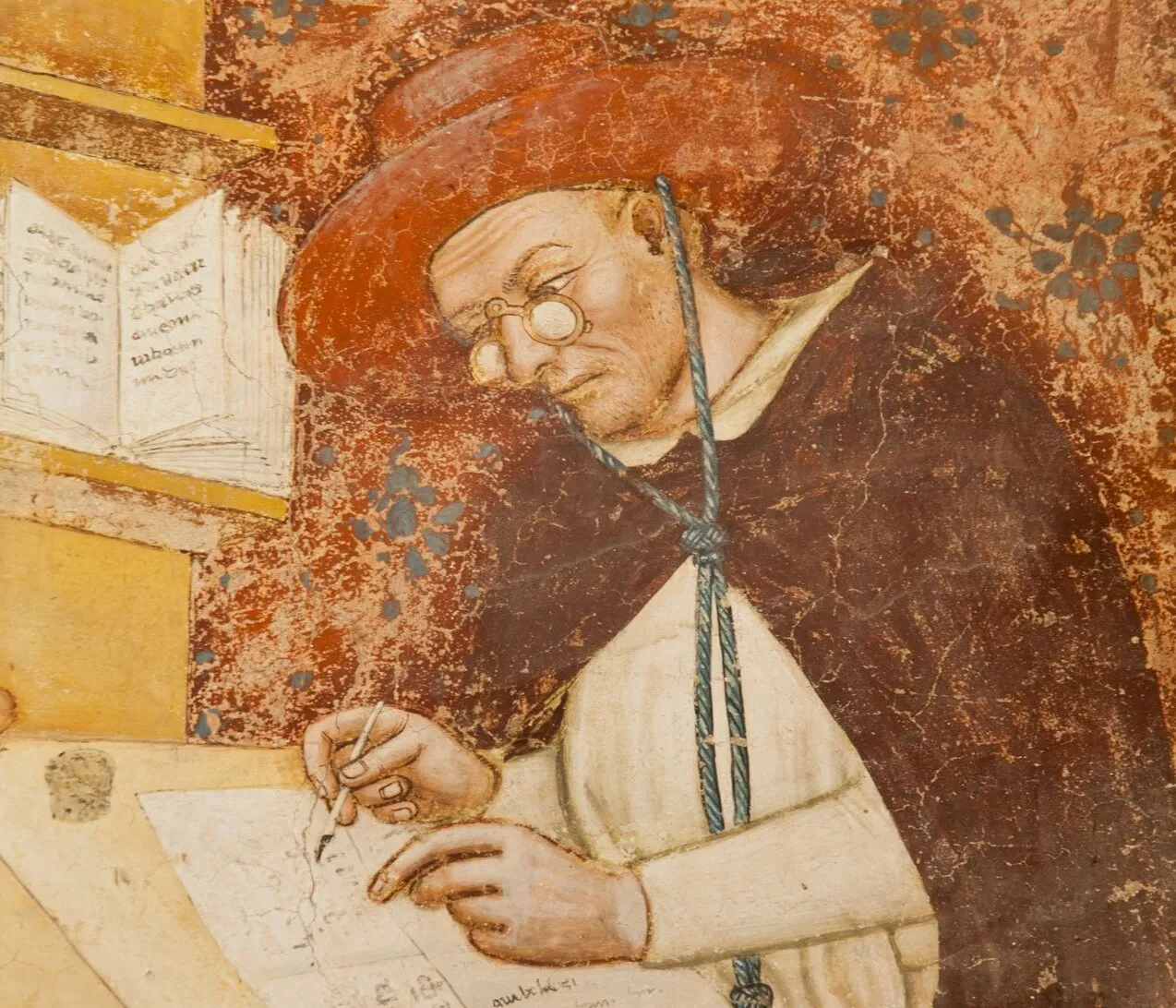
How it began
Scholars such as Ibn al-Haytham and Roger Bacon had written about how curved glass magnifies. Around 1286 someone in northern Italy, probably near Pisa, made convex lenses to set in a frame and hold before the eyes. In 1306 the friar Giordano da Pisa told a Florence congregation that the art of making spectacles was not yet twenty years old.
How it works
A convex lens is thicker in the middle than at the edges. Light passing through it bends towards the thick part, so rays from a near page converge as if they came from further away, which an ageing eye can focus.
Why it mattered
Spectacles created a trade in grinding and polishing glass lenses. Within three centuries, lenses that were good and cheap enough were available to put in the opening of a camera obscura, and later to build telescopes and microscopes.
Limits and what replaced it
Early lenses were small, weak and full of bubbles and colour fringes. Better glass, calculation and the achromatic lens slowly turned the craft into a science.
Today
Lens grinding grew into the optical industry; many camera makers, from Zeiss to Hoya, began with lenses for the eye.