Maxwell's three-colour photograph
17 May 1861 (Royal Institution, London)
James Clerk Maxwell showed that three photographs taken through red, green and blue filters, projected together, could rebuild a colour image. Every colour camera since uses the same idea.
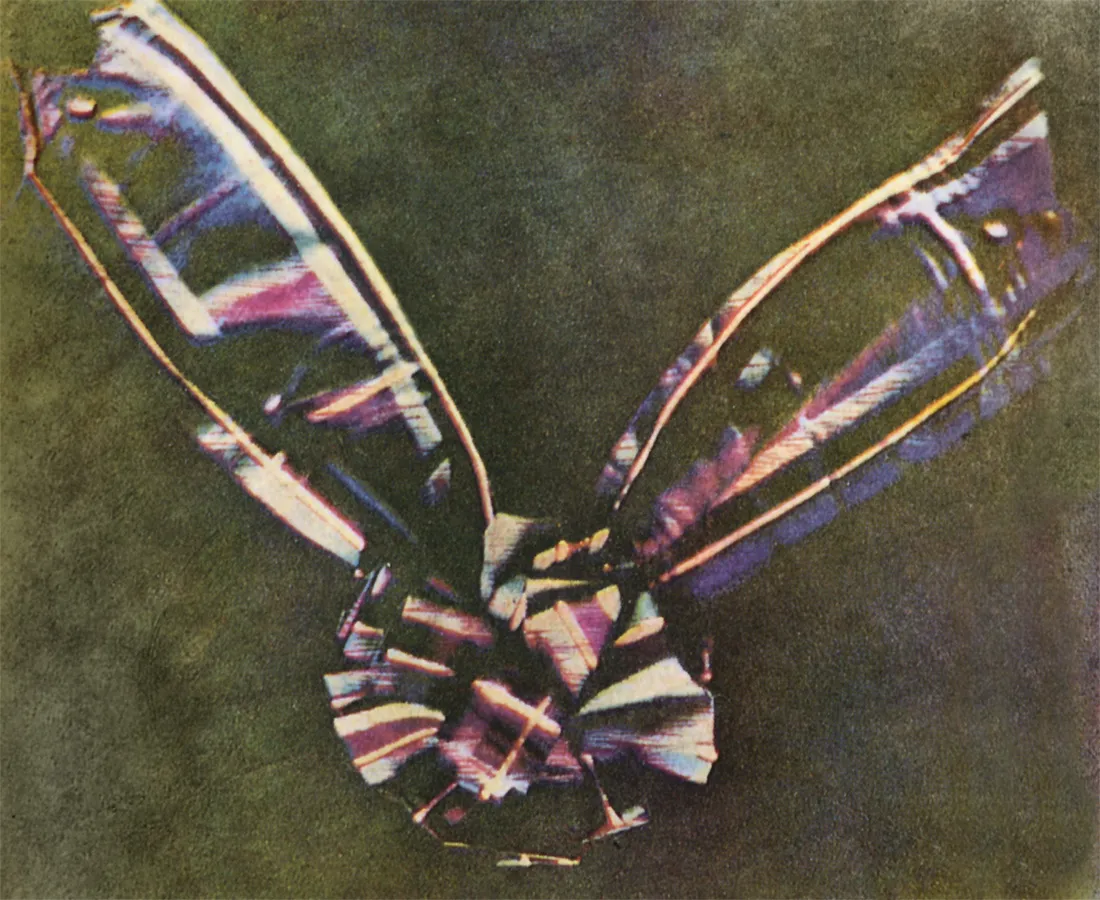
How it began
Building on Thomas Young’s idea that the eye has three kinds of colour receptor, the Scottish physicist James Clerk Maxwell proposed in 1855 that any colour could be recorded with three photographs. In 1861 he asked the photographer Thomas Sutton to photograph a tartan ribbon three times, through red, green and blue-violet filters.
How it works
Each black-and-white plate records how much of one colour the scene reflects. Positives of the three were projected through the same three filters and lined up on a screen, so the lights added together. Where red and green light overlap, the eye sees yellow; all three together look white. This is additive colour.
Why it mattered
Maxwell’s demonstration was the first colour photograph, and it set out the principle behind almost all colour photography: split the light into three, record each part, then recombine them. Additive screens such as the Autochrome and every digital sensor’s colour filter mosaic use it directly; dye-layer films use its subtractive twin.
Limits and what replaced it
The plates of 1861 were barely sensitive to red or green. In 1961 Kodak researchers showed that the ribbon’s red dye happened to reflect ultraviolet, which the red record caught. Practical colour needed emulsions sensitive to all colours, which came from the 1870s onward.
Today
Digital sensors split light into red, green and blue just as Maxwell proposed.