The cyanotype
1842 (Herschel)
John Herschel’s iron-based process makes Prussian-blue prints with sunlight and water, and no silver. Anna Atkins used it for the first photographically illustrated book.
How it began
John Herschel, who had already found the fixer hypo and coined the words photography, negative and positive, kept experimenting with light-sensitive salts. In 1842 he described a process using iron compounds instead of silver.
How it works
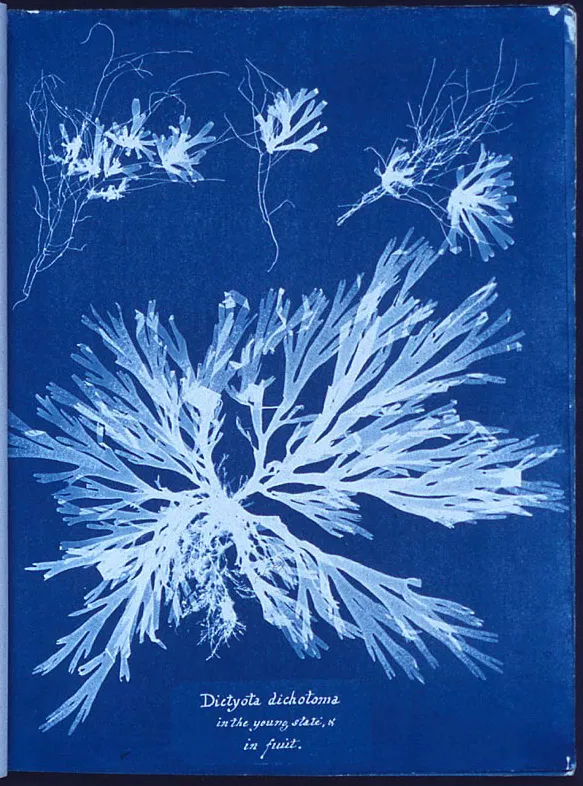
Paper coated with ferric ammonium citrate and potassium ferricyanide is exposed under a negative or an object. Light reduces the iron, and where it falls an insoluble Prussian blue forms. Washing in water removes the rest, so the print is fixed simply by rinsing.
Why it mattered
It was cheap, permanent and easy. Anna Atkins laid seaweeds directly on the paper to make Photographs of British Algae from 1843, often called the first book illustrated with photographs. From the 1870s architects and engineers copied plans as blueprints.
Limits and what replaced it
It is slow and only blue, so it never suited portraits. Diazo and then photocopying replaced blueprints, but artists still use the process.
Today
Artists and schools still make cyanotypes, and the process gave the word blueprint to engineering.