Lippmann colour photography
1891 (announced); 1908 (Nobel Prize)
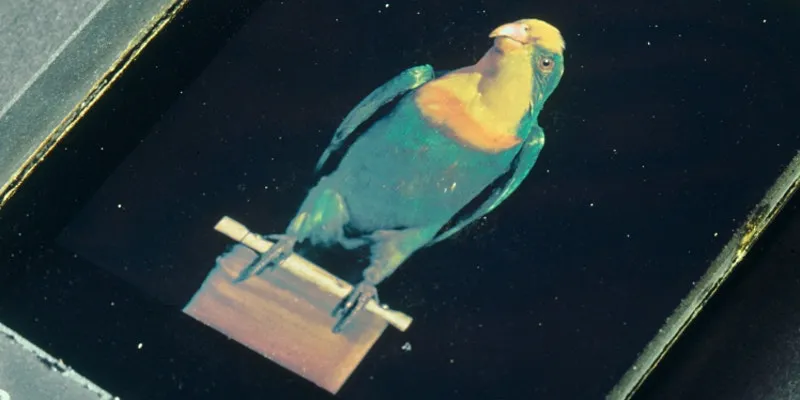
Gabriel Lippmann recorded colour with no dyes at all: light reflected from a mercury mirror formed standing waves in a fine emulsion, which replayed the colours. Nobel Prize, 1908.
How it began
Every other colour method of the time used filters and three exposures. The physicist Gabriel Lippmann looked for a way to record the wavelength of light directly, and announced one in 1891.
How it works
A glass plate with an extremely fine-grained emulsion is exposed with a pool of mercury behind it. Light reflects off the mercury and interferes with itself, making a pattern of standing waves in the emulsion. After development, layers of silver are spaced by half a wavelength of each colour, and in reflected light they send back the original colour.
Why it mattered
It was the first direct, single-exposure colour photograph, and earned Lippmann the 1908 Nobel Prize in Physics. Its colours could be startlingly accurate.
Limits and what replaced it
Plates needed long exposures, could be seen only at one angle, and could not be copied. The autochrome of 1907 was far more practical, and Lippmann’s method faded from use.
Today
Lippmann plates are museum pieces, but the interference principle is used in holograms and anti-counterfeit marks.