35mm cine film
1891–92 (Edison's laboratory)
Eastman's film slit to 35mm with four perforations per frame on each side, made for Edison's Kinetoscope. It became the world's cinema standard, and later the width of still-camera film.
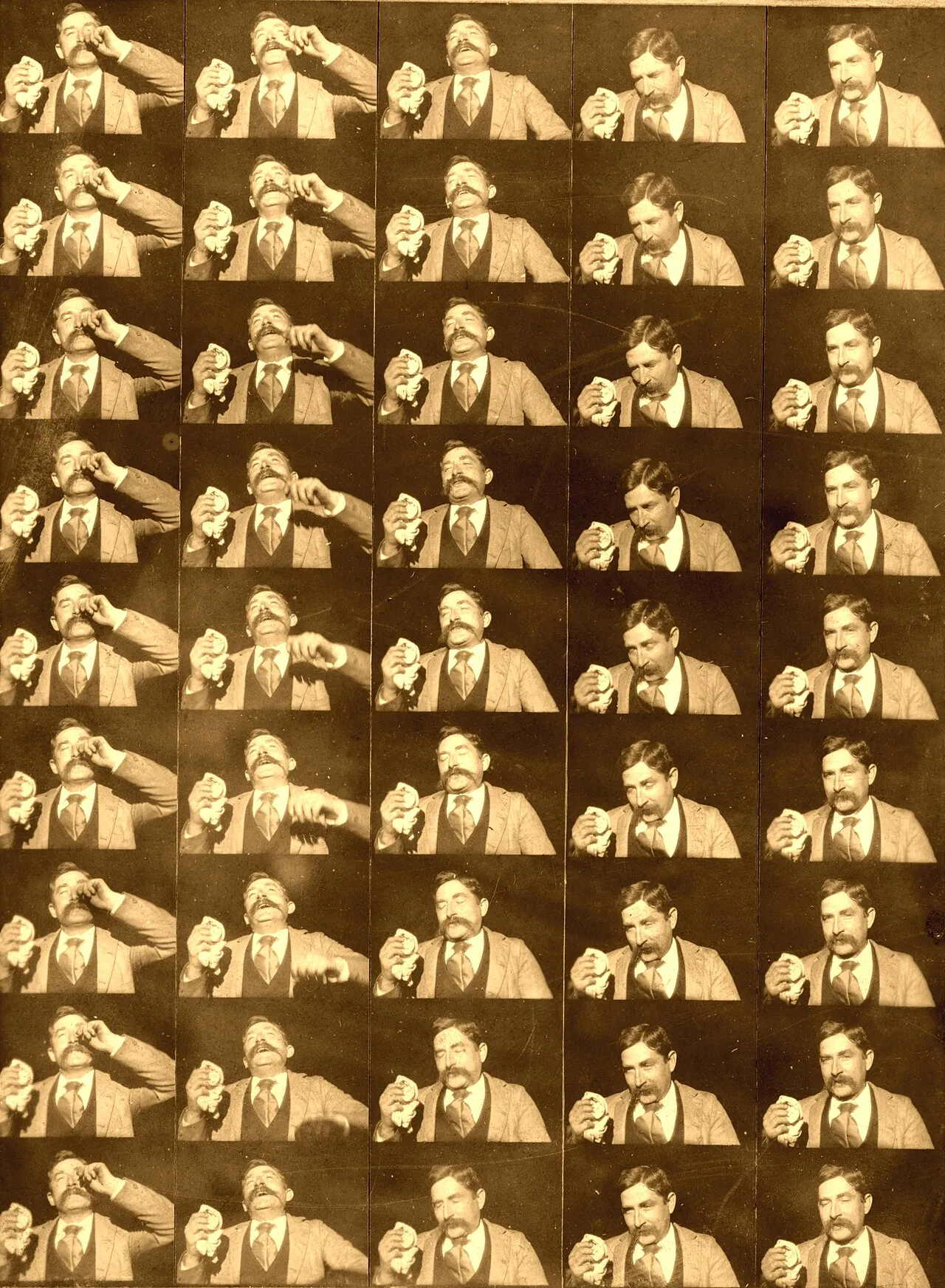
How it began
At Thomas Edison’s laboratory in New Jersey, William Kennedy Laurie Dickson needed film for the Kinetoscope, a peephole viewer for moving pictures. He took Eastman’s celluloid film, about 70mm wide, and split it in half lengthwise. He added four perforations on each side of every frame so sprockets could pull it steadily.
How it works
The film runs vertically through the camera and projector, one frame below the next. Each frame is about 24mm wide and 18mm tall (the exact size varied before sound). The perforations give precise registration, so each frame stops in exactly the same place.
Why it mattered
The Lumière brothers and other early filmmakers adopted the same film, and by 1909 it was the international standard. Because 35mm film was made in huge quantities for cinema, it was cheap and good, which is why Oskar Barnack chose it for the Leica. Laid sideways and doubled, the cine frame became the 36 × 24mm still frame now called full frame. See formats and crop factor.
Limits and what replaced it
In cinema, digital cameras and projectors largely replaced film after about 2010, but 35mm film is still shot by some filmmakers and remains the basis of the 135 still format.
Today
35mm is still a cinema format and, as 135 film, the most widely used still film.
Sources
- Wikipedia: 35 mm movie film ↗
- Eder, ch. LXXI (p. 514): cinematography