The Kodak camera
1888 (patented 4 September)
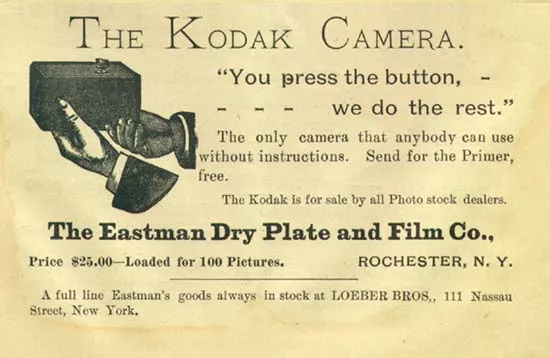
A small box camera loaded with a hundred exposures, sold with the promise 'You press the button, we do the rest'. Developing became someone else's job, and anyone could take photographs.
How it began
George Eastman had built a dry-plate company in Rochester, New York, and then a roll film for plate cameras. In 1888 he sold a camera built around the film: a leather-covered box, small enough to hold, already loaded with film for a hundred pictures. He invented the name “Kodak” because he liked the letter K and wanted a word that was short and could not be mispronounced.
How it works
The owner pointed the camera, pressed the button, turned a key to wind on the film and pulled a string to cock the shutter. The lens was fixed-focus, so there was nothing to set. When the film was used up, the owner mailed the whole camera back to Rochester. Kodak developed the film, printed the round pictures and sent the camera back reloaded.
Why it mattered
“You press the button, we do the rest” separated taking pictures from the skilled chemistry of making them. Photography became a pastime for millions, and the snapshot of family life was born. Eastman’s real business was film and processing, and that model shaped the industry for a century.
Limits and what replaced it
It was expensive at first and its results were modest. Cheaper models followed, above all the $1 Brownie of 1900, and folding Kodaks that fitted in a pocket.
Today
Its model, a simple camera with developing done by a lab, lasted through disposable cameras and into phone photography.
Sources
- Primary source US Patent 388,850: Camera (Google Patents) ↗
- Wikipedia: Kodak camera ↗
- Eder, ch. LXVI (p. 485): film and amateur photography